
Volume I (2001-2007)
The View From The Ground (Volume I) was an online publication produced from 2001–2007 by Chicago journalist Jamie Kalven, photographer Patricia Evans, and technologist David Eads. Publishing from an office in a vacant unit at the Stateway Gardens public housing development, it was conceived as a human rights monitoring strategy: a vehicle for documenting conditions of life in abandoned communities.
Upon launching The View, Kalven noted in passing, with tongue in cheek, that it was published under the auspices of the Invisible Institute. Today the wisecrack has become reality: the Invisible Institute is a robust journalistic production company operating out of the Experimental Station on the South Side of Chicago.
During his years of immersion in high-rise public housing, Kalven sought to facilitate the work of other journalists – as source, fixer, colleague – in an effort to improve the quality of public discourse. (In 2002, On The Media reported on this aspect of his work.)
You can read all the posts from Volume I below.

→ “Kicking the Pigeon” is a series of seventeen articles by Jamie Kalven published between July 6, 2005 and February 16, 2006 on the View From The Ground. It describes the incidents and underlying conditions that gave rise to Bond V. Utreras, a federal civil rights case that has figured centrally in the public conversation about police accountability in Chicago.
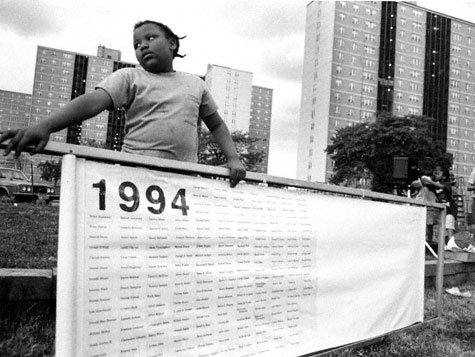
For five years—from January, 1994 to December, 1998—a group of citizens gathered on the corner of 35th and State at twilight on the first Sunday of each month to read the names of those lost to violence on the South Side. Initiated by Rev. Susan Johnson of Hyde Park Union Church, Dr. Sokoni Karanja of Centers for New Horizons, and myself, Vigil Against Violence was at once an expression of resistance and an occasion for reflection. It was, as one regular participant put it, a way of “making oneself available to the problem.”
Sustained from month to month and year to year by the moral passion and clarity of purpose of Rev. Johnson, and nourished by the sense of fellowship that developed among the core group of participants, the vigils were simple occasions: a few words of introduction by a member of the community, the reading of the names, and sometimes a little music.
On this first Sunday of the month of October in a year when Chicago may again lead the nation’s cities in homicides as it did last year, The View remembers Vigil Against Violence in a photo essay by Patricia Evans composed of images drawn from the posters we created each month to announce the next vigil.
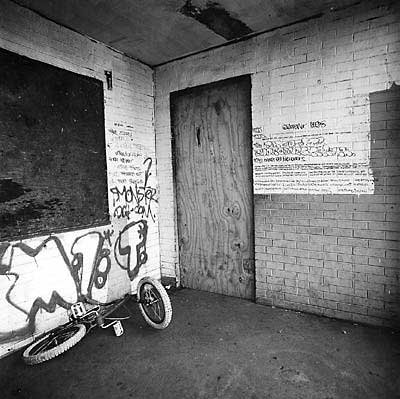
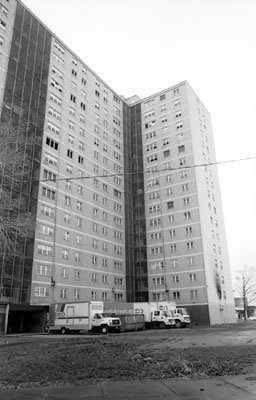
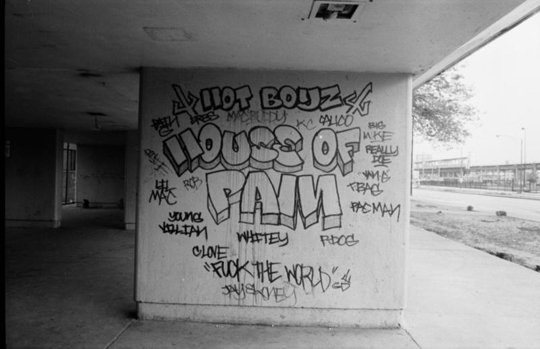
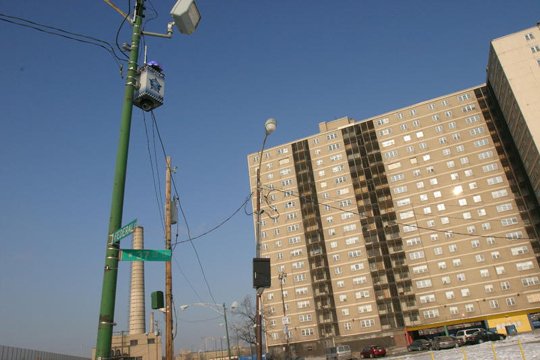
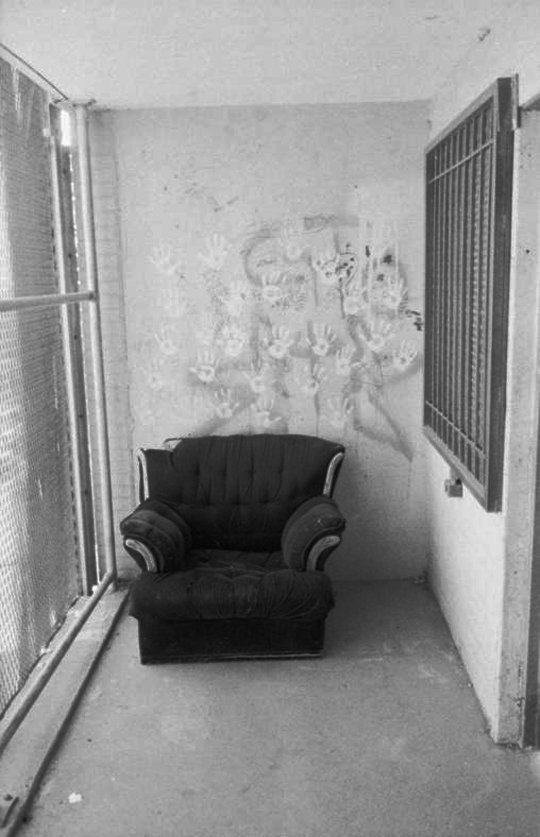
On a wall beside a vacant apartment on the seventh floor of 3542 South State Street—a high-rise at Stateway Gardens known as "The House of Pain"—words of ardor and longing flow across rows of brick.
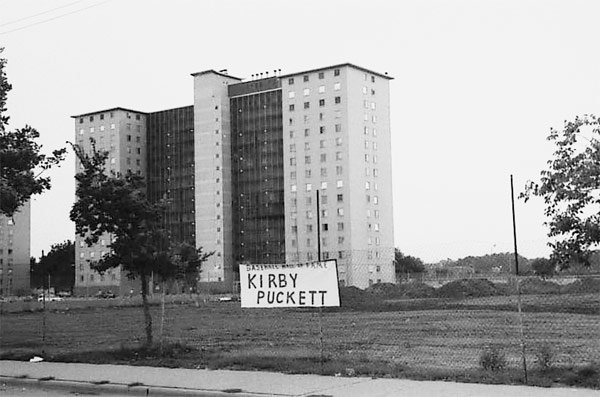
On Sunday, August 5, Kirby Puckett will be inducted into the Baseball Hall of Fame in Cooperstown, New York.
Puckett spent his entire 12-year career with the Minnesota Twins. He was a member of two World Series championship teams and was selected as an All-Star ten times. He retired in 1995 with a .318 career batting average. Today he is an executive vice-president in the Twins organization.
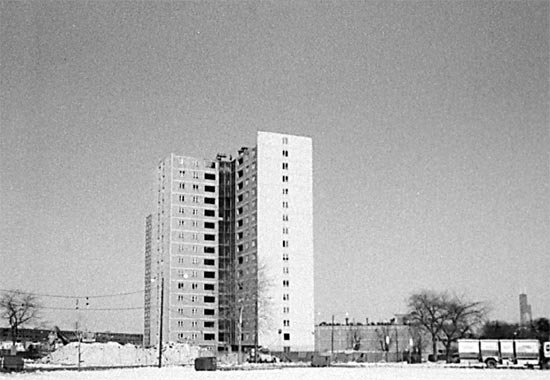
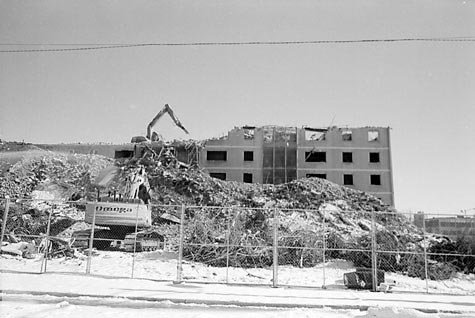
Kirby Puckett grew up in the Robert Taylor Homes. Last week several brightly colored signs celebrating his induction into the Hall of Fame appeared on the cyclone fence that encloses the vacant lot, as spacious as a baseball field, where 4444 South State Street once stood.
After a few days, the hand-lettered signs disappeared. One sign remains. It reads: “Danger: Demolition in Progress.”

Sylvia Timmons grew up in 3615-17 South Federal, the first building at Stateway Gardens to be demolished. Her family now lives in 3547-49 South Federal. A student at Harold Washington College, Sylvia has a particular interest in criminal law. When she was an eighth grader at Raymond Elementary School, her teacher asked the class to memorize the Preamble of the Constitution. Sylvia struggled with the assignment until she hit upon an idea: she turned the Preamble into a rap. In the cadences of the Founding Fathers, she located rhythms she recognized. Years later, the national aspirations articulated in the Preamble, remembered as music, are secure in her memory. Here, in celebration of the Fourth of July, is Sylvia’s rap.
Listen to Sylvia’s Rap (requires RealAudio player) [Audio link is broken; will be restored as soon as possible]
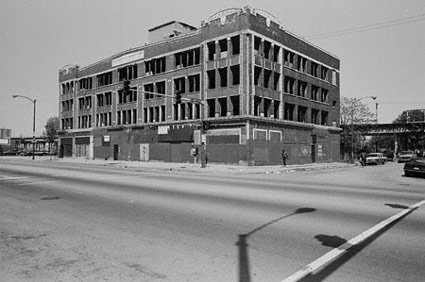
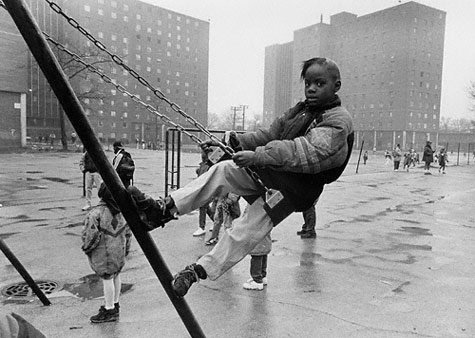
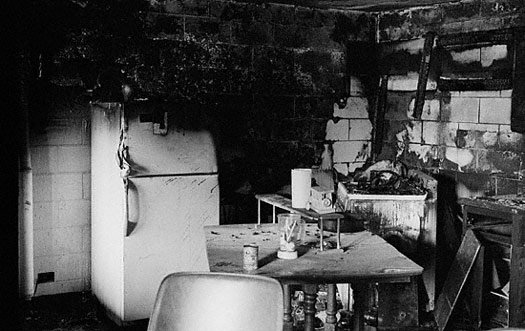

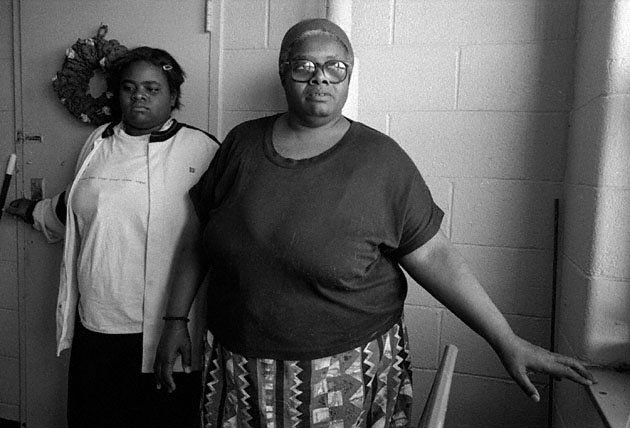
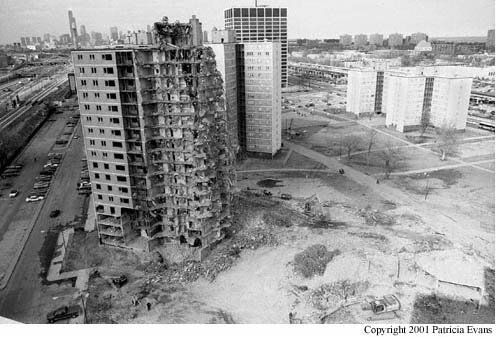


The CHA high-rise located at 2822 S. Calumet must have been a convenient location for the families who lived there until recently—especially for those with school-aged children. Dunbar High School is less than half a block away to the south on Martin Luther King Drive. And directly across Calumet, just a few steps away, is the John B. Drake Elementary School.
Today 2822 S. Calumet is empty. It was one of the buildings vacated during the recently completed second phase of the CHA’s relocation plan. When the relocation process began last spring, 120 of the building’s 203 units were occupied. The last residents moved out at the end of September.
Awaiting eventual demolition, 2822 S. Calumet now stands vacant in the midst of a dense, vital South Side neighborhood. It is sandwiched between two large, well-managed, middle-class developments—South Commons to the west, Prairie Shores to the east—that are home to many city workers, police officers, and employees of the nearby Michael Reese Hospital and McCormick Place convention center. Apart from the elementary school, its immediate neighbors on the block are the 2nd Ward Streets and Sanitation office at 29th and Calumet and the 21st District Police Station at 29th and Prairie.
In view of the CHA’s long experience with the human and legal consequences of failure to secure vacant units [see “In Memory of Eric Morse” – Parts I and II], and in view of questions that have been raised about its handling of contracts for securing vacant units [see “Denial of Access to Access Denied”], one would expect the housing authority to have taken care to secure 2822 S. Calumet and other recently vacated buildings adequately during the interval between closing and demolition.
In fact, one can easily see—from a block away or driving past on King Drive or looking out a window at Prairie Shores or South Commons—that 2822 S. Calumet is wholly unsecured. On all four sides of the building there are window openings that anyone—including a child—could easily climb through.
Vacant Property Security [VPS], the recipient of millions of dollars of contracts from the CHA over the last few years, was responsible for securing the building. At some point during the last two months—since the closing of the building at the end of September—VPS secured door and window openings on the first three floors using metal panels. Today 25 of the 88 openings are open. VPS panels lay on the ground or hang askew from the building, as small children pass by on their way to and from school.
These conditions are due to poor workmanship. Many of the panels do not fit the openings, leaving large gaps that make it easy to pull them off.
The VPS warehouse is located eight blocks away at 2540 S. Federal. How many times in recent days have VPS staff driven past the panels—some of them emblazoned with the VPS name and phone number—dangling from window openings at 2822 S. Calumet?
How many times have CHA staff going to and from meetings at various sites on the South Side or commuting to and from their homes driven past the obviously unsecured high-rise?
A Streets and Sanitation driver who works out of the facility next door said that 2822 S. Calumet had been in its present condition “for at least three weeks.” It would be interesting to know how many complaints the City, the CHA and VPS received during this period from people who live and work in the area.
The only call I am aware of was made on the afternoon of December 4 by Peter Bately of Access Denied, VPS’s principal competitor, to Duwain Bailey, CHA’s director of operations, to alert him to the dangerous conditions at the building. At that time, Mr. Bately requested that The View not publish any information about or images of the conditions at 2822 S. Calumet until the problem had been addressed, for fear of attracting anti-social activity to the unsecured vacant building across from a school.
As we post this story, a VPS crew is at 2822 S. Calumet beginning to restore the panels.
More than any evidence we have presented to date in our ongoing coverage of physical conditions that threaten the safety of CHA residents and their neighbors, the hazardous conditions at 2822 S. Calumet raise inescapable questions about the CHA’s ability to manage contracts, monitor performance, and make necessary adjustments when contractors do not fulfill the terms of their contracts.
November 22, 2002
Mr. Terry Peterson, Chief Executive Officer Board of Commissioners Chicago Housing Authority 626 W. Jackson Blvd. Chicago, IL 60661
Dear Mr. Peterson and Commissioners:
I am writing to request that the Chicago Housing Authority make public the reports submitted by the independent monitor of the relocation process, Thomas Sullivan.
Under the CHA’s Plan for Transformation, more than 15,000 families will be relocated; some several times. The process is far advanced, and the pace is accelerating. This year roughly 700 families were relocated; next year some 1,600 families are scheduled to be relocated. These moves have profound implications for individuals and for families, for public housing communities undergoing relocation and for neighborhoods to which CHA tenants are moving.
The Relocation Rights Contract governing the relationship between the CHA and tenants provides for monitoring of the relocation process. It does not specify how that function is to be performed. The CHA and the Central Advisory Council (CAC), the city-wide assembly of elected resident leaders, negotiated an agreement to contract with an independent monitor for the purpose of conducting an inquiry into the relocation process and making recommendations as to how it might be improved. Mr. Sullivan of the law firm Jenner & Block was selected to perform this function. A highly respected lawyer and former U. S. Attorney, Mr. Sullivan is a figure of unimpeachable integrity, competence, and independence. Working with several colleagues, he has conducted a wide-ranging investigation–observing every aspect of the relocation process and conducting interviews with residents, CHA staff, service providers, property managers, developers, and other participants in the process. Mr. Sullivan has submitted four reports and is preparing a final report.
The CHA would make a major contribution to the quality of public discourse about the Plan for Transformation by making available Mr. Sullivan’s reports.
I work at the Stateway Gardens development. Over the past year, five high-rises have been emptied at Stateway; three have been torn down; two are currently being demolished. When Stateway residents have raised concerns about the relocation process, the CHA has been responsive. On several occasions, Mr. Peterson, you have come to the development yourself to observe conditions on the ground. And members of your staff have worked closely with resident leaders to improve the relocation process.
It is in the spirit of this ongoing dialogue that I urge you to make public the reports of the independent monitor. By releasing Mr. Sullivan’s recommendations, the CHA would provide the basis for informed discussion that would deepen public understanding, enforce accountability on the various parties involved, and nourish possibilities for innovation.
Releasing the reports would also be prudent practical politics. By one avenue or another, they will eventually find their way into the public forum. It would be far more constructive, if they were made public by the CHA.
Finally, release of the reports would make it possible to assess the monitoring process itself. Has it served its intended purpose? In view of the fact that Mr. Sullivan’s contract runs only to the end of this year and the CHA is obligated to continue to provide for monitoring, how might this function best be performed in the future?
The View From The Ground began publication in the spring of 2001, as the relocation process was gathering momentum. The closing words of the first piece posted on The View seem even more relevant today:
Hope is a strenuous discipline. It demands that we acknowledge the history of abandonment that created present conditions and that we openly confront present realities. In the end, the greatest danger posed by our impoverished discourse about public housing is that we will fail to see and so will waste opportunities for humane, pragmatic strategies that are well within our reach.
Release of the Sullivan reports would be an act of civic statesmanship at a critical moment in the “transformation” of public housing.
Sincerely yours,
Jamie Kalven
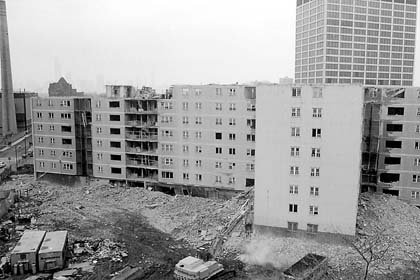
There is widespread concern about the quality of information available to residents living in public housing communities undergoing relocation, demolition, and redevelopment. This concern is shared by the Chicago Housing Authority, resident leaders, and housing advocates.
What do residents know about the CHA's "Plan for Transformation"? On the basis of our experience at Stateway Gardens, it is possible for residents to be at once uninformed and deeply knowledgeable.
Consider the question that has been asked again and again by CHA residents at community meetings convened for the purpose of presenting the Plan for Transformation—a plan under which thus far more than half of the family public housing units in the city have been demolished and scarcely any new housing has been built. The question takes a somewhat different form depending on where the meeting is held. On the West Side, residents ask, "When the Bulls built the United Center, they continued to play in the old Stadium until the new stadium was ready. Why is this different?" On the South Side, they ask, "When the White Sox built the new Comiskey Park, they continued to play in the old Comiskey Park until the new park was ready. Why is this different?"
Consider what residents living in communities being "transformed" see from their windows and what they hear as they go about their days. This slide show evokes the latter stages of the demolition last spring of 3517-19 South Federal—a building known as "The Kingdom"—as seen and heard by residents living in 3547-49 South Federal, a building now empty and being prepared for demolition later this fall.
Plans are in progress for the redevelopment of abandoned communities such as Stateway into "mixed income neighborhoods" that will provide quality housing for at least some of the families that have been forced to relocate. The federal government has committed resources to the redevelopment process. Resident leaders are engaged in ongoing negotiations with the CHA to make sure the city honors its commitments. Amid unresolved issues, competing agendas, and contingencies, these processes are advancing. Yet they remain largely invisible to residents. What vision of the future can one hold in focus, when one looks out the window at the dismantling of one's community? What messages can be heard over the sounds of demolition?
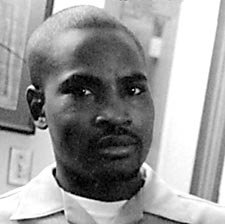
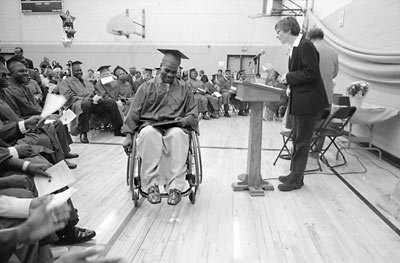
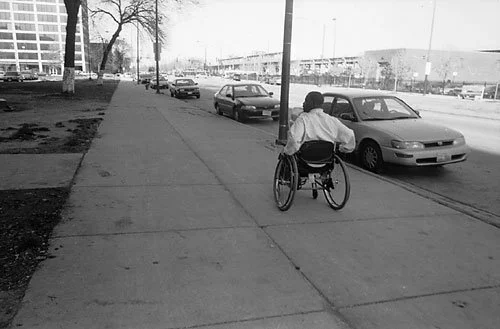
Good afternoon, my name is Mario Bailey. For those of you who may not know my story, I am a wheel chair bound paraplegic as a result of gangbanging. I have a severed spine from a gunshot.
When I was first paralyzed, I felt as though my life was over; I felt as though I didn’t want to live any more, because I did not want to face the unknown. It’s all over because I can’t walk.
For the past year or so, I have been going through a mental struggle to turn my thinking around, to find something positive resulting from the shooting. With the help of some dear friends, I am beginning to realize that although the shooting was the end of one life style, it was also the beginning of another. The very bullet that put me in this chair could have easily killed me; instead I was spared – WHY?
While looking for some answers, I decided to go back and finish high school. Having achieved that goal, I can see that I need to set more goals for myself, because accomplishments are gratifying; therefore, I have decided to pursue a higher education, and perhaps work on a degree.
With the proper education, and my background, I’m convinced that I can carry a message of HOPE to the generations coming behind me. Although the imagery is not crystal clear yet, I can see that as I reach forward for the door to my future, it is opening wider and wider, in order to accommodate me, and this ole chair.
Thank You, I’m Mario.
—Mario Bailey
See “Off The Lease: Mario Bailey” – Part I and Part II; and “Mario Bailey: Graduation Day.”
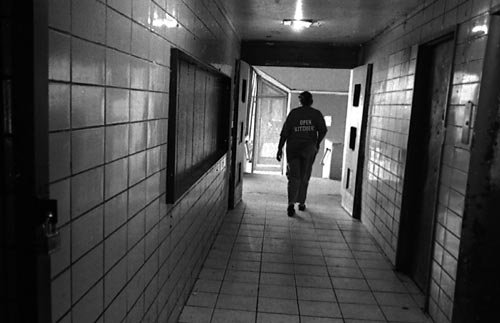
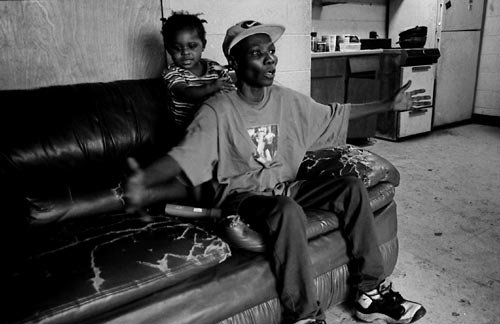
It all begins with an idea. The return of children to school last month marked the end of the Summer Food Service Program for this year. Funded by the Illinois State Board of Education, the program extends the anti-hunger programming offered in the public schools through the summer months. Over a 47 day period, an army of volunteers serve breakfast and lunch to children throughout the Chicago Housing Authority. At its height in the mid-1990’s, the program budget was $7 million. There were 224 sites at which 1,500 volunteers daily served 18,000 breakfasts and 27,000 – 30,000 lunches. As the dismantling of Chicago public housing has advanced in recent years, the scope of the program has diminished. Yet it remains an extraordinary administrative and logistical achievement: a glimpse of what is possible, when resources are made available for residents to provide services to their neighbors. Take a look.
For five years—from January, 1994 to December, 1998—a group of citizens gathered on the corner of 35th and State at twilight on the first Sunday of each month to read the names of those lost to violence on the South Side. Initiated by Rev. Susan Johnson of Hyde Park Union Church, Dr. Sokoni Karanja of Centers for New Horizons, and myself, Vigil Against Violence was at once an expression of resistance and an occasion for reflection. It was, as one regular participant put it, a way of “making oneself available to the problem.”
Sustained from month to month and year to year by the moral passion and clarity of purpose of Rev. Johnson, and nourished by the sense of fellowship that developed among the core group of participants, the vigils were simple occasions: a few words of introduction by a member of the community, the reading of the names, and sometimes a little music.
On this first Sunday of the month of October in a year when Chicago may again lead the nation’s cities in homicides as it did last year, The View remembers Vigil Against Violence in a photo essay by Patricia Evans composed of images drawn from the posters we created each month to announce the next vigil.


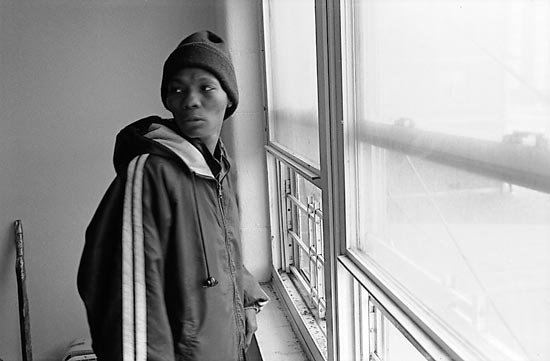
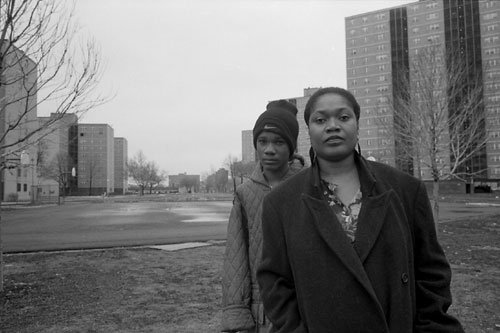

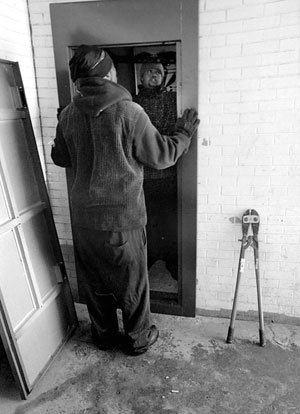
On a wall beside a vacant apartment on the seventh floor of 3542 South State Street—a high-rise at Stateway Gardens known as "The House of Pain"—words of ardor and longing flow across rows of brick.
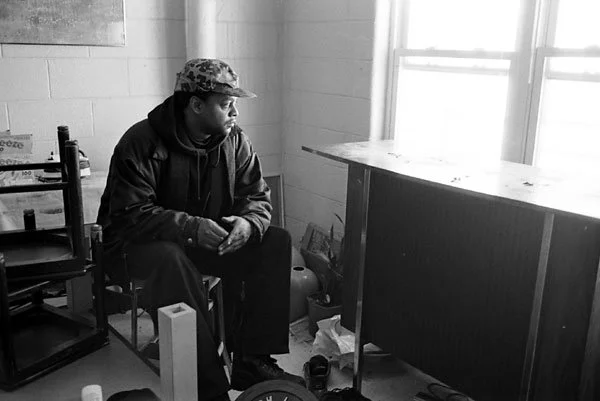

2002
2001
2003
I apologize for the lapse in publication. For several months, The View has been experiencing at first hand the rigors of forced relocation. Our office was located in 3544 South State Street, one of the Stateway Gardens high-rises demolished over the last few months. It was our understanding that the CHA would prepare space in one of the remaining Stateway buildings for the programs housed in the office. After delays and confusion, it was communicated by various means that none of these programs would be given alternative space at Stateway, if I was in the office.
We conceived of our office in 3544 South State—a five-bedroom apartment on the first floor—as a small settlement house: a common home for neighboring programs and initiatives that support and enrich the lives of Stateway residents. Acting on behalf of the Stateway Local Advisory Council (LAC)—the resident council—my colleagues and I established working relationships with an array of institutions and invited them to work out of the office. Among them: the CARA Program (a job training organization working with at non-leaseholders); the Mandel Legal Clinic of the University of Chicago Law School (with which we collaborate on a police accountability project); the Legal Assistance Foundation of Metropolitan Chicago (providing legal services); the Family Institute of Northwestern University (providing mental health services); and Archeworks, a non-profit design studio. Traditions of resident employment in the office evolved into an independent organization, 32 Degrees, that facilitates public health programs and trains residents as outreach workers. The office also served as a base for reporters (from Chicago, national, and neighborhood media), documentary-makers (from NPR, PBS, CBS’s “60 Minutes II”), and researchers exploring public housing issues. It was in this rich, nourishing ecology that The View was born and developed.
When it became apparent that programs serving Stateway residents were, in effect, being held hostage by the CHA’s refusal to provide me with space, I withdrew from the office I had helped create. In the intervening months, I have worked out of my pick-up truck, the Chicago Bee Branch public library at 3647 South State, and the LAC office at 3653 South Federal. The LAC has generously invited me to reestablish The View at its office, and I am in the process of doing so.
I mention this matter now for two reasons:
First, the question of how the CHA responds to public criticism—and to its critics—is central to the piece that follows on the independent monitor of the relocation process. Large public and private institutions can always invoke seemingly neutral reasons (e.g., budgetary constraints, shifting funding priorities, obscure regulations and contract provisions that suddenly cry out to be enforced, etc.) to justify attempts to silence their critics—or more precisely, to induce them to censor themselves. This tendency is perhaps best thought of as an institutional reflex rather than as a conscious policy: in the absence of an explicit commitment to open public discourse, official responses to criticism will be skewed in that direction.
Second, I want to reassure readers that The View is back. I have stepped away from relationships I value, in order not to put the work of friends and colleagues at risk. This has involved a measure of loss for me. It has also renewed my sense of freedom. In coming months, we will work to increase the capacity of The View and to extend its reach. Among the stories we are preparing is a series on the policing of public housing and a journal of a demolition—an account of the process by which 3542-44 South State became a vacant lot.
It’s good to be back in action.
My first three reports dealt with the ongoing relocation process in Phase II (2002). My fourth report addressed the timing of future phases of the process. This report deals with my recommendations as to how various aspects of the process might be improved in future years.
Our agreement provides that I will consult with representatives of the CHA and the CAC to convey any interim recommendations I may have for improvements in the Phase II relocation process. Report No. 1 was submitted to you on July 24, Report No. 2 on August 5, and Report No. 3 on September 11. I now submit Report No. 4.
Our agreement provides that I will consult with representatives of CHA and CAC to convey any interim recommendations I may have for improvements in the Phase II Relocation process. Report No. 1 was submitted to you on July 24, and Report No. 2 was submitted to you on August 5. I now submit Report No. 3
Our agreement provides that I will consult with representatives of CHA and CAC to convey any interim recommendations I may have for improvements in the Phase II Relocation process. Report No. 1 was submitted to you on July 24. I now submit Report No. 2
Our agreement provides that I will consult with representatives of CHA and CAC to convey any interim recommendations I may have for improvements to the relocation process. Accordingly, I submit the following
2004

2005


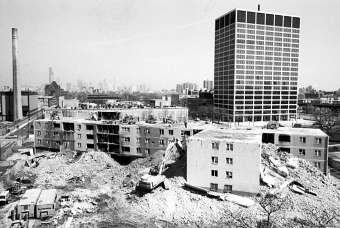

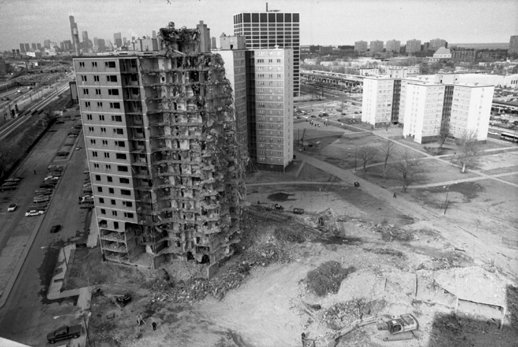
Today The View From The Ground resumes publication. It has been two years since we last posted a story. The reasons for this hiatus are personal. We certainly had not completed our mission. Nor had we exhausted the possibilities of The View. We were just beginning to grasp the nature of the tools that we, in collaboration with our readers, were developing.
We resume publication today in a radically altered landscape. Several years ago, I joked in print that the name of Chicago’s public housing strategy—“The Plan For Transformation”—was Orwellian: the Chicago Housing Authority, which had failed to provide “maintenance” and “security,” was now promising “transformation.” (Only as the process gathered momentum, did I realize that the truly Orwellian word was “plan.”) Yet the name has, in fact, proved accurate.
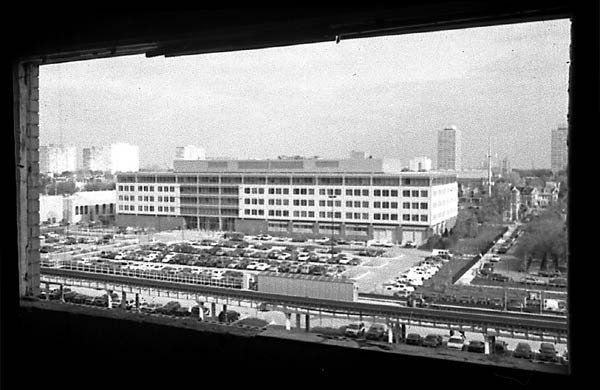
When we posted our first story in the spring of 2001, the Stateway Gardens public housing community, the ground from which we viewed the city, was largely intact. Today the “State Street corridor,” dominated by the Robert Taylor Homes and Stateway Gardens, has indeed been transformed. No other word will do. Once the largest concentration of public housing in the nation, it is now a post-apocalyptic landscape, block after block of vacant land. Of the twenty-eight high-rises that comprised Robert Taylor, two remain standing; of the eight Stateway buildings, one remains. At these and other former public housing sites throughout the city, developers have erected billboards proclaiming the names of the new “mixed income communities” they are building on the land cleared by demolition. Stateway Gardens, for example, has been renamed “Park Boulevard.”
Until recently, a billboard promoting Park Boulevard stood at the corner of 35th and State, the northern boundary of Stateway. The sign was a montage of photographic images: a boy blowing on a dried dandelion, a grandfather with his arm draped around his grandson, a little girl held aloft by strong, loving arms. Lightly superimposed upon these images were a series of words: “family, dreams, life, diversity, laughter, happiness, hope, fun, together, learning, independence, sharing, success.” Four words were in a darker font than the rest. They occupied the foreground and formed the phrase:
A Community Coming Soon
This message was meant to be read with reference to the acres of vacant land to the south of the billboard. It was intended to promote the idea that the developers would create on this blank slate a new community embracing the qualities evoked by the words on the sign. The inescapable, if perhaps unintended, subtext of this message was that those words did not apply to the generations of Stateway residents for whom this place had been home. The redevelopment process is necessarily blind to the forms of community they have created. It is a process of erasure rather than renewal.
For two years, The View reported from the Stateway community, as it contended with the forces pushing it toward invisibility. The words “the view from the ground” suggest both a moral stance and a methodology. Our understanding of what they mean has deepened over time. In our initial statement of purpose, we wrote:
The tradition of reporting from which The View takes its bearings seeks to create the means for those who are voiceless and caricatured within the prevailing discourse to be heard and seen on their own terms.
This is not to claim, as some have said, that The View “gives voice to the voiceless.” Those in abandoned communities such as Stateway, who are barred from full participation in the society by conditions of structural exclusion, do not lack voices. They lack the means of self-representation. Using the crafts and media at our command, we have tried to make immediate the voices of those who have told us their stories.
We have done so as friends, as neighbors, and, in some instances, as actors in those stories. For a number of years, we have been deeply engaged in the life of the Stateway community. How does our solidarity with those we report on affect our reliability as reporters? Does it distort our vision? Or does it perhaps afford us access to perception? These are legitimate questions. We leave them to our readers to assess. We make no claims to journalistic “objectivity.” We do aspire to intellectual rigor. As the British journalist James Cameron observed in his memoir Point of Departure:
I still do not see how a reporter attempting to define a situation involving some sort of ethical conflict can do it with sufficient demonstrable neutrality to fulfill some arbitrary category of “objectivity” . . . . I may not always have been satisfactorily balanced; I always tended to argue that objectivity was of less importance than the truth, and that the reporter whose technique was informed by no opinion lacked a very serious dimension.
We have understood our work within the traditions of human rights reporting. This form of inquiry begins with the injury to human dignity in the individual case. Having established the reality and unacceptability of the abuse, it moves to interrogate larger systems. Is this instance part of a larger pattern? What is the extent of that pattern? What conditions contribute to the space in which such abuses occur?
This orientation is, for us, an essential aspect of the meaning of “the view from the ground.” We have sought to engage fundamental human rights issues by immersing ourselves in eight square blocks of the South Side–by staying close to the ground.
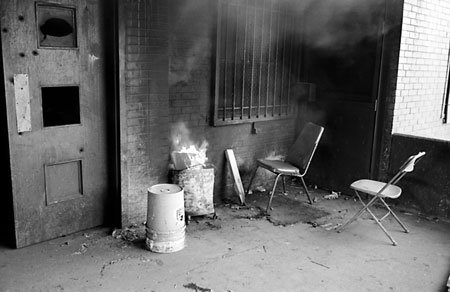
Today most of that ground, cleared and fenced, awaits redevelopment. Life persists amid the ruins. Some seventy-odd families inhabit the one remaining building, 3651-53 South Federal. Community members who have relocated elsewhere return to see friends, to hang out, to walk familiar streets. The Park District field house–known as “the center”–remains full of activity. Yet it would be false and sentimental to understate the extent of the damage.
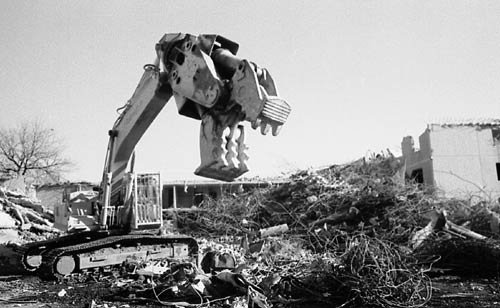
The machinery for disappearing people and erasing places is stunningly effective. We published The View from an office in a first floor apartment in one of the Stateway high-rises, 3542-44 South State. I knew everyone in the building; everyone knew me. I wrote a good deal about that building and know many more stories than I have written. After the building was closed, I came back almost every day over a period of months, sometimes for hours at a time, to bear witness to the process of demolition. Yet if I stand today on the vacant lot where 3542-44 South State was located, it takes a large, sustained effort of imagination to remember what was there.
Whatever else might be said about Chicago’s vertical ghetto, you could see it. As you moved through the city, it was difficult not to see public housing high-rises. Even registered in passing at the periphery of your vision as you drove by at 60 mph on the expressway, they posed questions, unsettled the mind, and abraded the conscience. The invisible ghetto fast replacing the high-rises allows us to move through the city unimpeded by moral friction and relieved of the danger of colliding with fundamental issues of social justice.
This restructuring of the city, it is important to recognize, is also remapping the geography of our moral imaginations—what we can see and what we can think, how issues are constructed and the parameters within which they are discussed.
It has been said that the more effective a regime of censorship is, the less people are aware of it. Some struggles over freedom of speech
have taken the form of demanding that censorship be kept visible, e.g., that material suppressed from publications be shown by white space (in India during the State of Emergency) or by ellipses (in Poland under martial law). (The latter practice gave rise to an inspired Solidarity button that read simply: “. . . “) Something similar can be said of structures of exclusion: the more invisible they are, the more effective. The less we are aware of them, the more powerfully they shape our experience of the world. They are part of the given; we are inside the whale. This is, arguably, the ultimate paradox of the Plan For Transformation: as the City has torn down the high-rises, it has fortified the structures of exclusion.
Paul Farmer has observed:
Human rights violations are not accidents; they are not random in distribution or effects. Rights violations are, rather, symptoms of deeper pathologies of power and are linked intimately to the social conditions that so often determine who will suffer abuse and who will be shielded from harm. If assaults on dignity are anything but random in distribution or course, whose interests are served by the suggestion that they are haphazard?
Narrative inquiries into the conditions underlying patterns of abuse must move against a powerful undertow. The boundaries of permissible discourse, the conventions of “on the one hand. . . on the other hand” journalism, and, in some instances, the very structure of the built environment resist such narratives. The costs of perception are high. It is easier to see assaults on human dignity as malfunctions of otherwise sound policies and institutions (the work perhaps of “a few bad apples”) than as “symptoms of deeper pathologies of power.”
We have no illusions about how difficult it is to tell such stories. It is not simply a matter of providing reliable information. Good journalistic work can readily be assimilated to the prevailing structures of perception. It is necessary to subvert those structures—to break through—in order to create space for fresh perception. This is the work of art and nonviolent resistance, as well as human rights reporting. The View is a point of intersection between these traditions, sensibilities, and conversations.
The View will continue to report from the ground. We will report from the places to which people have been disappeared. And we will describe the machinery by which individuals, populations, and issues are rendered invisible. Above all, we will work to develop narrative, analytic, and graphic strategies to illuminate the pathologies of power.
We don’t know where our inquiries will take us. We have a strong sense of direction but no map. We invite readers to join our ongoing conversation about how best to tell particular stories. What are the requirements of the narrative? the most effective lines of inquiry? the best means of making the invisible visible?
This much is clear. Conditions of structural exclusion are ultimately enforced by violence: by particular blows inflicted by particular hands on particular bodies. That is our point of departure—the ground from which we take our bearings—as we now resume The View.
The View From the Ground is an occasional publication of the Invisible Institute—a set of relationships and ongoing conversations grounded at the Stateway Gardens public housing development on Chicago’s South Side. In the tradition of human rights monitoring, our aim is to deepen public discourse by providing reliable information about conditions on the ground. The View orients from the perspective of those living in abandoned communities. There are, we recognize, other perspectives on the changes transforming inner city neighborhoods. We are mindful of these perspectives. Our first responsibility, however, is to evoke the experience of those on the ground—those for whom these neighborhoods are home. Public discourse is deformed by the absence of this perspective. The View seeks to inject it into the public conversation. Investigative journalism and human rights reporting are often challenged on the ground that they do not afford the powerful an adequate opportunity to tell their side of the story. Such criticism is based on a misconception about the nature of such reporting. Powerful institutions and individuals do not lack vehicles for expressing their views and asserting their interests. The tradition of reporting from which The View takes its bearings seeks to create the means for those who are voiceless and caricatured within the prevailing discourse to be heard and seen on their own terms. Such reporting does not purport to be “balanced” in the sense that the reporting in the mainstream press does. (Indeed, one of its aims is to correct distortions that arise from the conventions of “objective” journalism.) That does not, however, mean that it claims an exemption from high standards of craftsmanship and rigor. On the contrary, the moral authority of a human rights monitoring effort rests ultimately on the quality of its reporting. That is the basis on which we expect The View to be judged.
The View From The Ground is dedicated to enriching the public conversation about a range of issues associated with abandoned communities. We need your help to broaden and deepen that conversation. If you find The View useful, if you think it provides information and access to perception not available elsewhere, we ask that you help us extend its reach. Who do you know who might benefit from The View? Please recommend it to them and urge them to subscribe. Do you know of networks through which The View might be made available? If so, please let us know. The View is a tool for holding public institutions accountable to the marginalized and disenfranchised. Its impact has exceeded our expectations.That impact would be further enhanced, if public officials and other decision-makers knew it was being read and discussed by an expanding number of engaged citizens. Thanks for your help in spreading the word.
2006



The August issue of Chicago Magazine contains an article by David Bernstein on Jamie Kalven’s legal confrontation with the City of Chicago over the subpoena demanding his notes. Bernstein places the controversy against the background of Kalven’s effort as a young man to complete the manuscript on the American tradition of freedom of speech on which his father, Harry Kalven, Jr., was working when he died.
On June 27, Judge Arlander Keys ruled on two City motions seeking to compel Jamie Kalven to turn over his notes and answer certain questions in connection with the Bond case. Judge Keys’ opinion denied the City’s motions, except insofar as they apply to notes relating to his conversations with the plaintiff Diane Bond–i.e., matters about which he has been willing to testify. The City has filed a motion for reconsideration of the ruling. Kalven has also filed a motion for partial reconsideration, arguing that his notes on his conversations with Ms. Bond are “journalistic work product” and hence protected. The parties have until July 28 to reply to one another’s briefs.




11-15-07 “Chicago police abuse cases exceed average” by Susan Saulny in the New York Times.
11-15-07 “Certain areas have more bad cops, attorney says” by Michael Higgins in the Chicago Tribune.
11-1-07 “Chicago to overhaul troubled police department,” a report by Ben Calhoun on National Public Radio.
10-31-07 “Why is the city hiding scandals?” a column by Carol Marin in the Chicago Sun-Times.
10-30-07 “Omerta is word between city hall and police HQ,” a column by Don Rose in the Chicago Daily Observer.
10-29-07 “On rogue cops, Daley misses larger point,” a column by Dawn Turner Trice in the Chicago Tribune.
10-29-07 “In public interest, name cop, accuser,” a commentary by Dennis Byrne in the Chicago Tribune.
10-28-07 “Let new OPS chief investigate police,” a column by Steve Hundley in the Chicago Sun-Times.
10-26-07 “Chicago alderman request police complaint list” by Susan Saulny in the New York Times.
10-26-07 “Appeals court to decide if cops’ names disclosed” by Fran Spielman in the Chicago Sun-Times.
10-26-07 “Judge tells aldermen she can’t name cops” by Don Babwin, Associated Press.
10-25-07 “Daley ignoring rising toll of rogue cops,” a column by Mary Mitchell in the Chicago Sun-Times.
10-25-07 “List of cops still under seal” by Jeff Coen and Gary Washburn in the Chicago Tribune.
10-25-07 “Judge says no to aldermen seeking names of accused officers,” a report by Charles Thomas on ABC 7 News.
10-24-07 “Daley defends decision not to name accused cops” by Gary Washburn in the Chicago Tribune.
10-24-07 “Daley blasts aldermen on cop petition” by Fran Spielman in the Chicago Sun-Times.
10-23-07 “Police claims merit scrutiny” by Curtis Black, Community Media Workshop Newstips.
10-23-07 “Some complainants seek to ‘enhance their case in court,’ superintendent says” by Gary Washburn in the Chicago Tribune.
10-22-07 “Aldermen file petition seeking list of cops with multiple complaints” by Mike Robinson, Associated Press.
10-19-07 “Aldermen: Daley needs to give up names of cops” by Fran Spielman in the Chicago Sun-Times.
10-19-07 “28 aldermen demand names of officers accused of excessive force” by Gary Washburn in the Chicago Tribune.
10-19-07 “Hidden from public view” by Jennifer Chen, Kimbriell Kelly and Jeff Kelly Lowenstein in the Chicago Reporter.
10-19-07 “Stop hiding names in cop complaints,” editorial in the Chicago Sun-Times.
10-19-07 “Aldermen want names of cops accused of brutality,” a report by Andy Shaw on ABC 7 News.
10-10-07 “Cops clean house; investigation focuses on former bosses of seven arrested officers” by Frank Main, Annie Sweeney and Eric Herman in the Chicago Sun-Times.
10-7-07 “Among the worst; officer in elite unit may have benefitted from ‘circle-the-wagons mentality’: expert” by Frank Main in the Chicago Sun-Times.
10-3-07 “City withholds list of accused police” by David Heinzmann and Gary Washburn in the Chicago Tribune.
7/23/07 “Leading push to hold police accountable” – column by Dawn Trice in the Chicago Tribune.
7/22/07 “Eliminating Rogue Cops” – editorial in the Chicago Tribune.
7/20/07 “Chicago revamps investigation of police abuse, but privacy fight continues” by Libby Sander in the New York Times.
7/20/07 “City aims to stop rogue cops” by Gary Washburn and David Heinzmann in the Chicago Tribune.
7/19/07 “They thought they could run completely amok” by Frank Main and Fran Spielman in the Chicago Sun-Times.
7/19/07 “Don’t handcuff police reform” – editorial in the Chicago Sun-Times.
7/19/07 “Fine time to fix many ills among Chicago’s finest” by Eric Zorn on the Chicagotribune.com.
7/19/07 commentary by Steve Rhodes in The Beachwood Reporter.
7/18/07 “Daley defends cop unit under fire” by Gary Washburn and David Heinzmann in the Chicago Tribune.
7/18/07 “Elite cops rack up complaints” by David Heinzmann, et al, in the Chicago Tribune.
7/18/07 “Cop complaint list released – names hidden” by Frank Main, et al, in the Chicago Sun-Times.
7/18/07 “Hard to trust Daley ‘reform’” – column by C
arol Marin in the Chicago Sun-Times.
7/18/07 report on “Eight Forty-Eight” on Chicago Public Radio.
7-17-07 “What are they hiding?” by Frank Main and Abdon Pallasch in the Chicago Sun-Times.
7-17-7 “City holds up details on cop investigations” by David Heinzmann in the Chicago Tribune.
7-13-07 “Judge orders release of police data” by Curtis Black in Community Media Workshop Newstips.
On October 25, Judge Lefkow denied the motion of a group of aldermen to intervene in Bond v. Utreras in an effort to obtain the police documents she had earlier ruled are public. She no longer has jurisdiction over the matter, she said, because the case is on appeal before the U.S. Court of Appeals. On July 9, she had lifted the protective order with respect to the City, thereby removing any legal barrier to providing aldermen with the documents. On that occasion, she recalled, she had said in effect, “This is a political question. You go fight it out.” Now, with her ruling on appeal, she added, “I don’t have a dog in this fight.”
The aldermen have filed a notice to appeal to the U.S. Court of Appeals.
Despite the absence of Judge Lefkow’s dog, the political fight over the documents has been intense. The aldermanic intervention provoked strong responses from Mayor Daley, the acting superintendent of police, and the head of the police union, as well as from a variety of commentators. Here is a sampling of the news coverage and the debate:
11-1-07 “Chicago to overhaul troubled police department,” a report by Ben Calhoun on National Public Radio.
10-31-07 “Why is the city hiding scandals?” a column by Carol Marin in the Chicago Sun-Times.
10-30-07 “Omerta is word between city hall and police HQ,” a column by Don Rose in the Chicago Daily Observer.
10-29-07 “On rogue cops, Daley misses larger point,” a column by Dawn Turner Trice in the Chicago Tribune.
10-29-07 “In public interest, name cop, accuser,” a commentary by Dennis Byrne in the Chicago Tribune.
10-28-07 “Let new OPS chief investigate police,” a column by Steve Hundley in the Chicago Sun-Times.
10-26-07 “Chicago alderman request police complaint list” by Susan Saulny in the New York Times.
10-26-07 “Appeals court to decide if cops’ names disclosed” by Fran Spielman in the Chicago Sun-Times.
10-26-07 “Judge tells aldermen she can’t name cops” by Don Babwin, Associated Press.
10-25-07 “Daley ignoring rising toll of rogue cops,” a column by Mary Mitchell in the Chicago Sun-Times.
10-25-07 “List of cops still under seal” by Jeff Coen and Gary Washburn in the Chicago Tribune.
10-25-07 “Judge says no to aldermen seeking names of accused officers,” a report by Charles Thomas on ABC 7 News.
10-24-07 “Daley defends decision not to name accused cops” by Gary Washburn in the Chicago Tribune.
10-24-07 “Daley blasts aldermen on cop petition” by Fran Spielman in the Chicago Sun-Times.
10-23-07 “Police claims merit scrutiny” by Curtis Black, Community Media Workshop Newstips.
10-23-07 “Some complainants seek to ‘enhance their case in court,’ superintendent says” by Gary Washburn in the Chicago Tribune.
10-22-07 “Aldermen file petition seeking list of cops with multiple complaints” by Mike Robinson, Associated Press.
Today 28 aldermen filed a motion before Judge Lefkow seeking access to “certain Chicago Police Department documents.” At issue are the documents Judge Lefkow ruled are public in her July 2 opinion. The City has appealed that ruling to the U.S. Court of Appeals. The aldermen argue that Corporation Counsel Mara Georges, contrary to her representations to several courts, has “wrongfully withheld” the documents from them.
The following aldermen—a majority of the City Council—joined the motion: Toni Preckwinkle, Manuel Flores, Robert Fioretti, Pat Dowell, Leslie Hairston, Freddrenna Lyle, Sandi Jackson, Michelle Harris, Anthony Beale, Toni Foulkes, Joann Thompson, Latasha Thomas, Lona Lane, Willie Cochran, Howard Brookins Jr., Ricard Munoz, Sharon Denise Dixon, Billy Ocasio, Walter Burnett, Jr., Ed Smith, Scott Waguespack, Carrie Austin, Rey Colon, Emma Mitts, Brendan Reilly, Thomas M. Tunney, Helen Shiller, and Joseph A. Moore.
They are represented by Matthew Piers, Judson Miner, and Clyde Murphy. Miner and Piers were respectively Corporation Counsel and Deputy Corporation Counsel in Harold Washington’s administration. Murphy is Executive Director of the Chicago Lawyers’ Committee for Civil Rights Under Law.
As I have reported elsewhere, the City, in seeking a stay of Judge Lefkow’s order, repeatedly argued that any harm to First Amendment values would be mitigated because the City Law Office would provide the documents to “any City Council member who requests them. ”Having secured the stay, Corporation Counsel Georges refused Alderman Preckwinkle’s request for the documents on the ground that an appeal is pending.
The aldermen argue:
The Corporation Counsel should not be allowed to make representations to three courts, obtain relief based on those representations, and then fail to act in accordance with the representations.
They ask Judge Lefkow to direct the Corporation Counsel to provide them with the documents.They also ask that she modify the protective order, in order to allow plaintiff’s counsel to provide them with the documents.
The aldermen will appear before Judge Lefkow on Thursday, October 25, to present the motion.
Media coverage
Here is a selection of media coverage of the controversy over aldermanic access to the CPD documents:
10-19-07 “Aldermen: Daley needs to give up names of cops” by Fran Spielman in the Chicago Sun-Times.
10-19-07 “28 aldermen demand names of officers accused of excessive force” by Gary Washburn in the Chicago Tribune.
10-19-07 “Hidden from public view” by Jennifer Chen, Kimbriell Kelly and Jeff Kelly Lowenstein in the Chicago Reporter.
10-19-07 “Stop hiding names in cop complaints,” editorial in the Chicago Sun-Times.
10-19-07 “Aldermen want names of cops accused of brutality,” a report by Andy Shaw on ABC 7 News.
10-3-07 “City withholds list of accused police” by David Heinzmann and Gary Washburn in the Chicago Tribune.
The Daley Administration is subverting the democratic process by withholding important information from the public and their elected representatives. Its sovereign contempt for First Amendment principles bears comparison to the excesses of the Bush Administration in the national security realm. In defiance of an order entered by a federal judge, Corporation Counsel Mara Georges has denied City Counsel members documents they are seeking with respect to an issue of profound and immediate public importance—the Chicago Police Department’s failure to adequately investigate civilian complaints of abuse by officers.
Earlier this year, I intervened in Bond v. Utreras, a recently settled federal civil rights suit against the CPD, and petitioned Judge Joan Humphrey Lefkow to unseal certain documents produced by the City in pretrial discovery under a protective order (i.e., stamped “confidential”). These documents include a list of the officers who amassed the most civilian complaints over a five year period and the files of investigations of complaints against the five individual defendant officers in Bond.
I argued that police officers are public officials whom we entrust with extraordinary powers—the power to arrest and detain, to use force and, under certain circumstances, to kill. It is a first principle of our democracy that public officials in whom we vest substantial powers must be subject to close public scrutiny.
Judge Lefkow agreed. In an eloquent opinion, she ruled I could have access to the documents at issue and could make them public. “With so much at stake,” she wrote, “defendants simply cannot be permitted to operate in secrecy.”
The City filed an emergency motion to stay the ruling. In a hearing before Judge Lefkow, my lawyers argued against the issuing of a stay. They stressed that City Council members urgently need access to the documents in order to perform their duties. Judge Lefkow agreed to stay her order for a week to enable the City to seek a stay pending appeal from the U. S. Court of Appeals for the Seventh Circuit. At the same time, she instructed the City to provide the documents to any aldermen who asked for them. She was explicit in addressing the City lawyers. If aldermen approach you seeking these documents, she told them, “you or Ms. Georges or whoever they speak to can’t say this is subject of a protective order because it isn’t.”
In a futile effort to get Judge Pallmeyer of the Seventh Circuit to extend Judge Lefkow’s stay, a City lawyer argued, “So if there’s any public official who has an interest in the documents that are in question, any alderman . . . they can contact the city, the city attorneys, and the city attorney can provide them with that information.”
In its motion to the Seventh Circuit for a stay pending appeal, the City reiterated the same formulation: “We have agreed to make the confidential documents available to any City Council member who requests them.”
The Seventh Circuit granted the stay pending appeal. As often happens, the effort to suppress public information backfired. Faced with an avalanche of negative publicity—the headline in the Chicago Sun-Times asked “What Are They Hiding?”—Ms. Georges distributed to City Council members a version of the list of officers from which the names had been redacted. In a cover memo to the aldermen, she noted that the other documents at issue were “too voluminous” to provide at that time.
When Alderman Toni Preckwinkle recently requested copies of the list with the names and the documents pertaining to investigations of complaints against the Bond defendants, Ms. Georges replied that the City could not provide the documents because of the stay.
In other words, in seeking a stay from the Seventh Circuit, the City emphasized that it would, in keeping with Judge Lefkow’s ruling, make the documents available to any aldermen who asked for them. Having been granted the stay, Ms. Georges now tells aldermen who request the documents that the City cannot provide them because of the stay.
Withholding the documents on the basis of this transparently specious argument is an affront to the First Amendment—and to members of the City Council. They should insist on their right to this information.
A great deal is at stake. Circumstances have combined to create an historic opportunity for police reform in Chicago. Once the disputed documents are released, they will interact with information already in the public domain in ways that will deepen our understanding of patterns of police abuse and also of the systemic failures of supervision, monitoring, and discipline that have allowed abusive officers to operate for years with impunity.
Consider, for example, the ever-expanding Special Operations Section case. Six SOS officers have been indicted on an array of charges that include corruption, kidnapping, and robbery. They stand accused, in effect, of having operated a large-scale criminal enterprise out of their unit. A number of other SOS officers have been granted immunity in exchange for their testimony. The trial has not yet begun, yet the damage continues to mount. The state’s attorney’s office has dropped more than a hundred pending felony cases, because they were contaminated by one or another of the defendants. A large number of civil cases will inevitably be brought against the City. The U. S. Attorney’s office is undertaking its own investigation. Finally, last week Officer Jerome Finnegan, the alleged ringleader of the SOS racketeering operation, was arrested by federal agents for plotting the murder-for-hire of a former SOS officer who had agreed to testify against him and his co-defendants.
Although we do not yet know the full dimensions of the SOS scandal, it is clear that the monetary and institutional costs to the City will be vast. Against this background, what might we learn from the list of officers who have amassed the most civilian complaints over a five year period?
The names of officers were blacked out on the list Ms. George provided aldermen, but their unit numbers were included. It is thus possible, as was widely reported at the time, to determine that the top four officers on the list, each of whom have 50 or more complaints, are all members of SOS. The top ten SOS officers on the list, all of whom have 30 or more complaints, account for a total of 408 complaints over five years. Of these complaints, only three were sustained by CPD investigators. Two resulted in reprimands (among the mildest forms of discipline) and one resulted in a 15-day suspension. What would be revealed about the CPD’s systems of supervision, monitoring, and discipline, if we definitively knew that Finnegan and his co-defendants are at or near the top of the list?
There is, of course, reason to strongly suspect they are, but in the absence of the unredacted document this remains speculation. A classic tactic of official denial is to insist that anything short of definitive knowledge is not knowledge at all. And so, given a degree of uncertainty, Mayor Daley and other City officials continue to talk as if the problems with the CPD’s internal investigations are largely matters of public perception or, at worst, reflect the need for some administrative and staffing improvements in an essentially sound, workable system. They continue to engage in scandal management and to make reform gestures rather than coming to terms with the underlying problem and engaging in real reform.
If the CPD failed to adequately investigate hundreds of civilian complaints against the central figures in what may well prove the biggest police scandal in Chicago history, then we must confront the fact that the essential issue is not how to improve a flawed system of investigation. It is how to dismantle a complex apparatus of official denial—a regime of not-knowing—in which not only CPD investigations but also Ms. Georges’ City Law Office are components.
It is a necessary condition for meaningful reform that we openly confront the extent of this human rights debacle. Only then will the energies and resources of government be released from the massive ongoing effort required to deny these realities and become available to address them. Only then will we be able to go forward, on the basis of a sound diagnosis, to enact meaningful changes.
The alternative scenario, fast developing, is that the regime of not-knowing will collapse under the weight of metastasizing scandal and intensifying federal investigation. Reforms will then be dictated by outside authority. They will be the product not of the regeneration of our political institutions but of their utter failure.
The moment is at hand for members of the City Council to act. They should demand that the City honor its representations to the federal courts and give them access to the documents, thereby advancing the process of public acknowledgement that is a necessary prelude to genuine, enduring reform.
On July 2, Judge Joan Lefkow of the U.S. District Court granted my motion to unseal a number of documents regarding allegations of police abuse that the City of Chicago is trying to keep secret.
On July 9, in response to an emergency motion by the City, Judge Lefkow granted a stay of her order until 5:00 PM on July 16.
On July 16, the U.S. Court of Appeals for the Seventh Circuit issued a stay pending the City’s appeal of Judge Lefkow’s ruling.
This case is unfolding in the context of ongoing public debate in Chicago about police reform. A series of events have contributed to the intensity of that debate: the long-simmering controversy over police torture of African-American suspects by officers under the command of Commander Jon Burge; the indictments of six Special Operations Section officers on charges of corruption and brutality; the case arising from the surveillance video seen around the world of an off-duty Chicago police officer beating a female bartender; the case of six off-duty officers charged with beating other patrons at a bar; the resignation of Superintendent Phil Cline; the passage by the City Council on July 19 of an ordinance revising how the Office of Professional Standards investigates civilian complaints; and the appointment of a new OPS director. Taken together, these events have kept the debate over police accountability at the center of public attention.
The disputed documents are highly relevant to this debate. They were produced by the City under a protective order (i.e., stamped “confidential”) in the course of Bond v. Utreras, the case I wrote about in Kicking the Pigeon.
The documents at issue are:
A list of 662 officers with more than ten civilian complaints during a five year period.
A list of officers with more than ten complaints who were referred to the Chicago Police Department’s “early intervention” programs.
A list of officers with more than ten complaints who were assigned to the Public Housing South Unit.
The employee complaint histories of the defendant officers in Bond v. Utreras.
The CR (“Complaint Register”) files of investigations of complaints against the defendant officers.
The CR files of the investigations initiated by Ms. Bond’s complaints.
After the parties in Bond agreed to settle, I petitioned the court to lift the protective order with respect to the documents at issue.I am represented in this matter by Jon Loevy and Samantha Liskow of Loevy & Loevy.
Judge Lefkow’s opinion
In her July 2 ruling, Judge Lefkow found that “good cause” does not exist to keep the documents secret. In reaching that conclusion, she rejected the City’s argument that “granting Kalven access to the protected documents he seeks to obtain is prejudicial to defendants because it would make public documents that cast defendants in an unfavorable light while depriving them of the ability and opportunity to effectively respond to them”:
The fact that the allegations of police misconduct contained in the requested materials would bring unwanted, negative attention on defendants is not a basis for shielding the materials from public disclosure.The public has a significant interest in monitoring the conduct of its police officers and a right to know how allegations of misconduct are being investigated and handled.
Judge Lefkow expressed her confidence that the general public is “sophisticated enough” to understand that allegations of abuse do not constitute actual proof of abuse. And she observed that the City is not without resources to participate in public debate:
The City has its own public relations department and there are no doubt countless media outlets that would invite city officials to participate in an open and frank discussion regarding these and other allegations of police misconduct.
Judge Lefkow also rejected the City’s argument that the privacy interests of the police officers outweighs the public interest in the disputed documents.After noting that I had agreed to the redaction of private information such as addresses and Social Security numbers, she addressed the City’s contention that the documents are part of employee personnel files and thus protected from disclosure:
That information, though personal, has a distinct public character, as it relates to the defendant officers’ performance of their official duties. Without such information, the public would be unable to supervise the individuals and institutions it has entrusted with extraordinary authority to arrest and detain persons against their will.With so much at stake, defendants simply cannot be permitted to operate in secrecy.
In the July 9 hearing before Judge Lefkow regarding the City’s emergency motion for a stay, we emphasized that the documents at issue are highly time-sensitive, in light of the July 19 City Council vote on proposed OPS reforms. We argued that aldermen need access to this information, in order to evaluate the proposed legislation.Judge Lekfow responded by lifting the protective order with respect to the City, so that it would not be legally constrained from providing the documents to any aldermen who requested them.
The Documents
When the Seventh Circuit on July 16 stayed Judge Lefkow’s order pending appeal, it froze the legal controversy for the time being. (Here are the City’s motion and our response.) The political controversy over the disputed documents, however, intensified. On July 17, two days before the City Council vote on the proposed OPS ordinance, Mara Georges, the corporation counsel, conveyed to all fifty aldermen copies of the lists described above with the names of the officers redacted.
Ms. Georges’ cover memo to the aldermen gave this explanation of why the City had not provided the other documents Judge Lefkow had ordered released:
The other category of documents which have been ordered released are complaint register files which are too voluminous to attached to this memorandum.
Here are links to the redacted lists the City provided to the aldermen:
Media Coverage
The controversy over the documents has received a good deal of media attention. I have not made an effort to capture television coverage; it can be accessed on the websites of various local stations. Here is a selection of articles and commentaries:
7/23/07 “Leading push to hold police accountable” – column by Dawn Trice in the Chicago Tribune.
7/22/07 “Eliminating Rogue Cops” – editorial in the Chicago Tribune.
7/20/07 “Chicago revamps investigation of police abuse, but privacy fight continues” by Libby Sander in the New York Times.
7/20/07 “City aims to stop rogue cops” by Gary Washburn and David Heinzmann in the Chicago Tribune.
7/19/07 “They thought they could run completely amok” by Frank Main and Fran Spielman in the Chicago Sun-Times.
7/19/07 “Don’t handcuff police reform” – editorial in the Chicago Sun-Times.
7/19/07 “Fine time to fix many ills among Chicago’s finest” by Eric Zorn on the Chicagotribune.com.
7/19/07 commentary by Steve Rhodes in The Beachwood Reporter.
7/18/07 “Daley defends cop unit under fire” by Gary Washburn and David Heinzmann in the Chicago Tribune.
7/18/07 “Elite cops rack up complaints” by David Heinzmann, et al, in the Chicago Tribune.
7/18/07 “Cop complaint list released – names hidden” by Frank Main, et al, in the Chicago Sun-Times.
7/18/07 “Hard to trust Daley ‘reform’” – column by Carol Marin in the Chicago Sun-Times.
7/18/07 report on “Eight Forty-Eight” on Chicago Public Radio.
7-17-07 “What are they hiding?” by Frank Main and Abdon Pallasch in the Chicago Sun-Times.
7-17-7 “City holds up details on cop investigations” by David Heinzmann in the Chicago Tribune.
7-13-07 “Judge orders release of police data” by Curtis Black in Community Media Workshop Newstips.
On March 15, Jamie Kalven filed a motion to intervene in the Bond case for the purpose of challenging the protective order under which certain documents produced by the City in the course of the litigation are withheld from the public. These include a list of Chicago police officers who have been repeatedly charged with official misconduct, documents that reveal how the CPD addresses or fails to address misconduct charges, and the complaints files of the individual officer defendants.
Kalven is represented in this matter by Loevy & Loevy. The City has until April 3 to respond to the motion. Kalven will then have until April 10 to reply.
On January 1, I published an op-ed piece in the Chicago Sun-Times on Mayor Daley’s Commission on Police Integrity. Appointed in 1997 in the wake of a police scandal in the Austin and Gresham Districts, the Commission was charged with investigating the underlying causes of the scandal and making recommendations for reform. The Mayor welcomed the Commission’s report as “an excellent blueprint for change.” Yet nearly a decade later, I argued, the City has still not implemented the Commission’s primary recommendations.
In a letter to the Sun-Times published on January 9, Deputy Police Superintendent Debra Kirby, the head of the Internal Affairs Division, responded to my piece:
Jamie Kalven’s Jan. 1 commentary leaves citizens with the impression that the Chicago Police Department has done nothing since 1997 to address the issue of police misconduct. Nothing could be further from the truth. Many of the blue-ribbon committee’s recommendations for improved integrity and accountability have been fully implemented.
Apart from repeatedly asserting the CPD’s “commitment” to professionalism and accountability, Kirby makes several points. I will respond to each in turn.
* * * *
Both the Office of Professional Standards and the Internal Affairs Division actively investigate and respond to complaints regarding officer misconduct.
My point is not that the CPD has no systems for supervising, monitoring and disciplining officers. It is that those systems are ineffective. In an earlier Sun-Times op-ed piece, published on September 16, 2006, I used the CPD’s own statistics to demonstrate this. Since then, the CPD's data has been further analyzed by Dr. Steven Whitman, an epidemiologist who was an expert witness for the plaintiff in Bond v. Utreras. (Statistical tables generated by Dr. Whitman are available here.) Among his findings:
During 2002-2004, citizens filed 10,149 complaints alleging police abuses in the categories of excessive force, illegal arrest, illegal searches, racial abuse and sexual abuse. Only 124 of these complaints were sustained--slightly more than 1 percent.
If "meaningful discipline" is defined as a suspension of 7 days or more, only 19 of the 10,149 complaints resulted in "meaningful discipline"--a rate of less than 2 per 1,000 complaints.
According to a U. S. Department of Justice report, the national sustained rate for excessive force complaints filed with “large municipal police departments” in 2002 was 8 percent. By contrast, the CPD's sustained rate during 2004, the most recent year for which it has released figures, was less than half of one percent (0.48%). In other words, excessive force--brutality--complaints are 94 percent less likely to be sustained by the CPD than they are by other large municipal police departments across the country.
Contrary to Kirby's assertion that the CPD has "improved integrity and accountability" in the years since 1997, the percentage of sustained complaints steadily declined during the period 1999-2004. The sustained rate for all civilian abuse complaints decreased from 3.7% in 1999 to 0.6% in 2004 – a decline of 84%. The sustained rate for excessive force complaints decreased from 4.8% to 0.5% – a decline of 90%.
The odds that a CPD officer who abuses a citizen will receive meaningful discipline are in reality even less than 2 in 1,000--substantially less. Citizens who believe they have been victims of police abuse often do not file formal complaints. Among the reasons are fear of reprisals and distrust of the investigatory process. A national survey conducted by the U. S. Department of Justice found that only 10% of those who believed they suffered excessive force in an encounter with the police reported the incident to the agency employing the officer. If we use that baseline, an incident in Chicago in which a citizen believes the police used excessive force will result in meaningful discipline in 2 in 10,000 cases.
These numbers evoke the conditions of impunity under which abusive CPD officers operate. It is hard to believe, given such odds, that an officer with criminal tendencies would be deterred from wrongdoing by fear of being investigated and punished.
* * * *
To be clear, we have remained committed to rooting out bad cops who violate the public’s trust. The recent arrests of Special Operations Section officers underscores that commitment.
The CPD has repeatedly claimed that the SOS case and other recent indictments prove it has adequate systems in place to identify and discipline rogue officers. These indictments are not, however, evidence the system is working. They are evidence it is broken.
The internal investigation of the SOS officers was initiated after lawyers in the State’s Attorney’s Office informed the CPD that the officers in question were consistently missing court appearances. It was not triggered by the CPD’s supervisory and monitoring systems but by the intervention of another agency. It would be interesting to know how many citizen complaints the CPD had received over the years regarding these officers as individuals and as a group.
Similarly, the tactical officers in the Englewood district who recently pled guilty on charges arising from their practice of robbing drug dealers were not brought down by internal CPD mechanisms of accountability. The case was precipitated by federal agents who observed the officers interacting with drug dealers they had under surveillance. The agents’ interest was piqued, when they noticed a Fraternal Order of Police bumper sticker on the officers’ vehicle. One of these officers, it has been reported, had amassed 31 citizen complaints within the two years prior to his indictment, while another had amassed 24.
This is just one of many high-profile criminal cases over the years in which officer defendants proved to have high numbers of citizen complaints alleging abuses consistent with the pattern involved in the criminal case but had never received meaningful intervention and/or discipline.
Again and again, the CPD has responded the same way to cases such as these that carry the threat of a widening police scandal. It announces that bad cops will not be tolerated and that vigorous investigations are ongoing. The Mayor may appoint a special body to address the problem such as the Commission on Police Integrity in 1997 or the current panel advising him on selection of a director for the Office of Professional Standards. Then, when public attention wanes, the status quo is restored without any meaningful reforms having been instituted.
Consider, for example, the recent verdict in the case against the City brought by Michael Casali, an ATF agent, and his wife Diane Klipfel, a former AFT agent. In 1992, these federal agents reported criminal acts by Officer Joseph Miedzianowski to their supervisors. Described by federal prosecutors as “the most corrupt cop in Chicago history,” Miedzianowski is currently serving a life sentence for running a Miami-Chicago drug ring out of the Gang Crimes unit. By the time he was finally arrested in 1998, he had amassed more than 40 complaints; among them, 20 brutality complaints, none of which had resulted in meaningful intervention or punishment. In their suit, Casali and Klipfel charged that the CPD retaliated against them rather than investigating their complaints, allowing Miedzianowski and his cronies to terrorize them. After a five-week trial that included testimony from Superintendent Phil Cline, the jury found in favor of the couple and awarded them $9.75 million. In post-trial interviews, jurors made it clear that the crux of the case, as one of them put it, was the CPD’s “incompetent, lazy and overall negligent” investigation of Miedzianowski. Another remarked, “What investigation did the Chicago Police Department do? Mike and Diane were wronged. It was the city’s policies that created that.”
* * * *
In my op-ed piece, I noted that the Commission on Police Integrity recommended that the CPD institute a “fully computerized” early warning system to identify officers engaged in misconduct and that it emphasized the importance of tracking patterns with respect to groups of officers as well as individuals.
Kirby responds:
While we appreciate Kalven’s recommendations to track patterns of complaints against police officers . . . readers should know that we are already doing so . . .
Again, the issue is not whether or not the City has a system. It is the adequacy of that system. The City has repeatedly declared it is in the process of instituting a state-of-the-art computerized system for tracking patterns of misconduct. Technology may well be forcing the City’s hand: it is increasingly hard to justify the use of high tech tools to identify criminal patterns in the general population, while refusing to do the same with respect to criminals in uniform. There is, however, no evidence such a system has been implemented. What we know about the system currently in place is that it yields outcomes such as those described above. And we know that police officials responsible for investigating citizen complaints have acknowledged that the CPD does not currently track complaints by groups of officers. In other words, it chooses not to know things within its power to know about patterns of abuse.
Viewed against this background, Dr. Whitman's analysis of CPD data regarding officers who have amassed unusually large numbers of complaints is telling. Among his findings:
During the period May 2001 - May 2006, 10,387 officers had 0 to 3 complaints. Another 2,451 officers had 4 to 10 complaints. 662 officers had more than 10 complaints.
The 662 "repeaters" were named in 10,733 complaints. Only 236 or 2.2% of these complaints were sustained.
Only 22 of the 10,733 complaints or 0.2% resulted in "meaningful discipline"--i.e., a suspension of 7 days or more.
Of the 662 "repeaters," only 25% ever received any discipline, however nominal, while 75% were never disciplined at all.
Among the "repeaters," 33 officers were named in 30 or more complaints within a five year period. Of these, four had 50 or more complaints. Taken together, these 33 officers had, at a minimum, well over 1,000 complaints. Yet only 6 of these complaints were sustained and only one resulted in meaningful punishment.
The CPD has two programs that it describes as its “early warning system”: the Behavior Intervention System and the Personnel Concerns Program. The purpose of an early warning system is to identify officers in need of intervention before, in the words of the Commission on Police Integrity, “small problems become big ones.” It is a measure of the inadequacy of the CPD’s early warning system that only 89 (13.4%) of the 662 "repeaters" have been identified by these programs.More than 86% "repeaters" have not been identified as needing intervention; among them, officers who amassed 50 or more complaints over a five year period.
* * * *
The Commission recommended that the CPD provide closer supervision of tactical units assigned to enforcing narcotics laws, because this is the setting in which most abuses occur. According to Kirby:
. . . readers should know that we . . . have reorganized citywide response units to provide closer supervision with better tactical responses to monitoring officers and their actions.
I am not altogether sure what this means and whether it translates into more stringent accountability standards and practices. I do know that Superintendent Phil Cline stated, in the wake of the SOS indictments, that members of that unit would be placed under closer supervision. He also said he did not think it necessary to disband SOS altogether, as had been done to Gang Crimes in 2000 after Miedzianowski was convicted on racketeering charges for running a drug ring out of the unit. The underlying issue here goes to the deployment strategy adopted by the City. Instead of strengthening the units based in particular districts, it has opted to create special units that operate city-wide with a high degree of autonomy. A byproduct of this strategy, as we have seen with Gang Crimes and SOS, is that these units are relatively unaccountable and prone to high levels of abuse. What does it mean when Cline and Kirby say there will be "closer supervision" of these units? Will supervisors have access to effective tools for enforcing accountability? Will they be directed to make vigorous use of those tools?
* * * *
. . . Kalven claims that officers who are accused of misconduct have a “2-in-1,000” chance of receiving what he considers “meaningful punishment.” There is no question that Supt. Cline has prioritized the commitment to integrity, honesty and professionalism within the Chicago Police Department. For the record, Supt. Cline has recommended the terminations of more than 100 police officers—recommendations that are governed and decided solely by an independent police board.
My statement that officers accused of misconduct had a 99.8% chance of not receiving meaningful discipline is not based on the full universe of allegations of misconduct but on complaints involving direct abuse of citizens (excessive force, illegal search, etc.). There are a range of other sorts of administrative infractions and matters of non-performance that do not figure in this analysis.
Kirby responds by citing the number of officers Cline has recommended terminating during his three-and-a-half-year tenure. It is not surprising that in a force of 13,600 the superintendent would have occasion to recommend the firing for all causes of 100 officers over more than three years. This is, however, unresponsive to the point I am raising about the CPD's ineffectiveness in responding to citizen complaints of abuse. How many officers has Cline recommended terminating on the grounds that they abused citizens?
* * * *
Kirby closes her letter with these words:
Our mission and challenge are to discipline effectively and fairly without compromising the public’s trust or the morale of the more than 13,600 decent and hardworking men and women who serve this department and city every day.
That is indeed what is at stake. A small percentage of the police force commit the vast majority of the abuse. Allowed to operate with impunity, these “few bad apples” do great damage to both the public’s trust and the morale of the rest of the force.
Jamie Kalven