Denial of Access to Access Denied: Part V
In Part III of this series, The View erroneously reported that the CHA had received no responses to the request for proposals issued on June 14, 2002. In fact, it received two responses: from Vacant Property Security (VPS) and Kar-Anne’s Board-up Inc.
On August 20, 2002, the Board of Commissioners authorized the CHA to enter into contracts with VPS and Kar-Anne’s Board-up Inc. for a cumulative amount of $1,500,000. The terms of the contracts are for two years with an option for a third year. Under the contracts, VPS will secure vacant units by means of metal panels, while Kar-Anne’s Board-up Inc. will do so by means of plywood boards.
Several resident leaders were frustrated to learn that Access Denied had formally withdrawn from the bid process. “I wish they’d bid,” one of them remarked. “How can we support them, if they don’t bid?”
After the board meeting, I spoke with Duwain Bailey, CHA’s director of operations. He explained that the contracts just approved were intended for the CHA to use for emergencies and special needs. The CHA, according to Mr. Bailey, expects property managers to allocate sufficient funds for securing vacant units and will leave them free to use the contractor of their choice. This approach, he said, would allow VPS and Access Denied to compete for business at the development level.
On August 21, 2002, the day after the board meeting, Peter Bately and Andrea Brooks of Access Denied went to the offices of IRM Interstate Realty Management Company, which had recently been installed as the manager of the Robert Taylor Homes, to pick up a purchase order number and list of units to be secured under a scope of work they had verbally agreed on. According to Mr. Bately, while they were there, Kevin Collins, the CHA asset manager responsible for the Robert Taylor Homes, appeared and took Sarah Buckner, the property manager, aside. After speaking with Mr. Collins, Ms. Buckner told Mr. Bately and Ms. Brooks that Interstate was not going to use Access Denied. She did not, she said, have to pay for the securing of vacant units, because the CHA has a standing contract with VPS to perform that function.
When I heard about the episode at the Robert Taylor Homes, I contacted Kathyrn Greenberg, who handles “external communications” for the CHA, and requested a written statement outlining the housing authority’s policy on the securing of vacant units. Several days later, after consulting with Mr. Bailey, Ms. Greenberg provided the following statement:
The CHA’s contract for securing vacant properties was competitively awarded on August 20, 2002 by the CHA Board of Commissioners to Vacant Property Security and Kar-Anne’s Board Up. The CHA also requires that the private managers managing CHA properties determine the needs of their properties for the board up of vacant units and buildings and include in their budgets funding for those services. Pursuant to HUD and CHA procurement requirements, the property managers are to independently procure vendors for board-up services. The CHA will use the board up contracts just approved by the Board of Commissioners only if services are needed beyond what was expected and budgeted by the private managers.
It may or may not be relevant that Kevin Collins, until recently the CHA’s asset manager at the Robert Taylor Homes, has a brother, Michael Collins, who works for VPS. The essential point is that the policy articulated by the CHA can only work if it is understood and enforced by CHA field staff.
On December 2, Access Denied returned to the Robert Taylor Homes. IRM Interstate Realty Management had given them a purchase order number for work at 4429 S. Federal, and they had fabricated the materials—31 door panels and 46 window panels—required to do the job. When they arrived at the site, they found that 30 of the 31 units they had come to secure already had VPS panels in place. According to Mr. Bately, Ms. Buckner of Interstate told Access Denied that this was a mistake, that VPS was not supposed to secure those units. She asked for time to clear up the confusion. Two weeks later, she informed Access Denied that she was going to use VPS because the CHA would pay the bill.
This is hardly the fair, open competition that Mr. Bailey promised. When he learned of the situation at Robert Taylor, Mr. Bailey assured Mr. Bately that “Interstate will honor your purchase order.”
Mr. Bailey’s active interest in VPS’s performance under its CHA contracts is welcome. Several questions demand his attention. How is it that work for which the property manager at Robert Taylor had engaged Access Denied was done by VPS? Was this a mistake on the part of VPS? Was it a deliberate effort by VPS to deny business to Access Denied? And if so, how did VPS learn precisely which units Access Denied had been hired to secure?
In either case, it is striking that VPS, whether by accident or design, mobilized to secure those particular units at Robert Taylor, while elsewhere in the neighborhood a building it is contractually obligated to keep secure, 2822 S. Calumet, stood wide open.
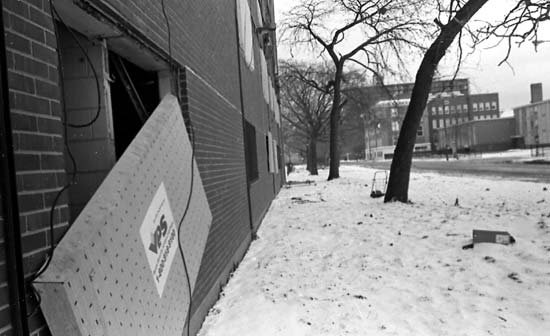
2822 S. Calumet
The CHA high-rise located at 2822 S. Calumet must have been a convenient location for the families who lived there until recently—especially for those with school-aged children. Dunbar High School is less than half a block away to the south on Martin Luther King Drive. And directly across Calumet, just a few steps away, is the John B. Drake Elementary School.
Today 2822 S. Calumet is empty. It was one of the buildings vacated during the recently completed second phase of the CHA’s relocation plan. When the relocation process began last spring, 120 of the building’s 203 units were occupied. The last residents moved out at the end of September.
Awaiting eventual demolition, 2822 S. Calumet now stands vacant in the midst of a dense, vital South Side neighborhood. It is sandwiched between two large, well-managed, middle-class developments—South Commons to the west, Prairie Shores to the east—that are home to many city workers, police officers, and employees of the nearby Michael Reese Hospital and McCormick Place convention center. Apart from the elementary school, its immediate neighbors on the block are the 2nd Ward Streets and Sanitation office at 29th and Calumet and the 21st District Police Station at 29th and Prairie.
In view of the CHA’s long experience with the human and legal consequences of failure to secure vacant units [see “In Memory of Eric Morse” – Parts I and II], and in view of questions that have been raised about its handling of contracts for securing vacant units [see “Denial of Access to Access Denied”], one would expect the housing authority to have taken care to secure 2822 S. Calumet and other recently vacated buildings adequately during the interval between closing and demolition.
In fact, one can easily see—from a block away or driving past on King Drive or looking out a window at Prairie Shores or South Commons—that 2822 S. Calumet is wholly unsecured. On all four sides of the building there are window openings that anyone—including a child—could easily climb through.
Vacant Property Security [VPS], the recipient of millions of dollars of contracts from the CHA over the last few years, was responsible for securing the building. At some point during the last two months—since the closing of the building at the end of September—VPS secured door and window openings on the first three floors using metal panels. Today 25 of the 88 openings are open. VPS panels lay on the ground or hang askew from the building, as small children pass by on their way to and from school.
These conditions are due to poor workmanship. Many of the panels do not fit the openings, leaving large gaps that make it easy to pull them off.
The VPS warehouse is located eight blocks away at 2540 S. Federal. How many times in recent days have VPS staff driven past the panels—some of them emblazoned with the VPS name and phone number—dangling from window openings at 2822 S. Calumet?
How many times have CHA staff going to and from meetings at various sites on the South Side or commuting to and from their homes driven past the obviously unsecured high-rise?
A Streets and Sanitation driver who works out of the facility next door said that 2822 S. Calumet had been in its present condition “for at least three weeks.” It would be interesting to know how many complaints the City, the CHA and VPS received during this period from people who live and work in the area.
The only call I am aware of was made on the afternoon of December 4 by Peter Bately of Access Denied, VPS’s principal competitor, to Duwain Bailey, CHA’s director of operations, to alert him to the dangerous conditions at the building. At that time, Mr. Bately requested that The View not publish any information about or images of the conditions at 2822 S. Calumet until the problem had been addressed, for fear of attracting anti-social activity to the unsecured vacant building across from a school.
As we post this story, a VPS crew is at 2822 S. Calumet beginning to restore the panels.
More than any evidence we have presented to date in our ongoing coverage of physical conditions that threaten the safety of CHA residents and their neighbors, the hazardous conditions at 2822 S. Calumet raise inescapable questions about the CHA’s ability to manage contracts, monitor performance, and make necessary adjustments when contractors do not fulfill the terms of their contracts.
An Open Letter To CHA
November 22, 2002
Mr. Terry Peterson, Chief Executive Officer Board of Commissioners Chicago Housing Authority 626 W. Jackson Blvd. Chicago, IL 60661
Dear Mr. Peterson and Commissioners:
I am writing to request that the Chicago Housing Authority make public the reports submitted by the independent monitor of the relocation process, Thomas Sullivan.
Under the CHA’s Plan for Transformation, more than 15,000 families will be relocated; some several times. The process is far advanced, and the pace is accelerating. This year roughly 700 families were relocated; next year some 1,600 families are scheduled to be relocated. These moves have profound implications for individuals and for families, for public housing communities undergoing relocation and for neighborhoods to which CHA tenants are moving.
The Relocation Rights Contract governing the relationship between the CHA and tenants provides for monitoring of the relocation process. It does not specify how that function is to be performed. The CHA and the Central Advisory Council (CAC), the city-wide assembly of elected resident leaders, negotiated an agreement to contract with an independent monitor for the purpose of conducting an inquiry into the relocation process and making recommendations as to how it might be improved. Mr. Sullivan of the law firm Jenner & Block was selected to perform this function. A highly respected lawyer and former U. S. Attorney, Mr. Sullivan is a figure of unimpeachable integrity, competence, and independence. Working with several colleagues, he has conducted a wide-ranging investigation–observing every aspect of the relocation process and conducting interviews with residents, CHA staff, service providers, property managers, developers, and other participants in the process. Mr. Sullivan has submitted four reports and is preparing a final report.
The CHA would make a major contribution to the quality of public discourse about the Plan for Transformation by making available Mr. Sullivan’s reports.
I work at the Stateway Gardens development. Over the past year, five high-rises have been emptied at Stateway; three have been torn down; two are currently being demolished. When Stateway residents have raised concerns about the relocation process, the CHA has been responsive. On several occasions, Mr. Peterson, you have come to the development yourself to observe conditions on the ground. And members of your staff have worked closely with resident leaders to improve the relocation process.
It is in the spirit of this ongoing dialogue that I urge you to make public the reports of the independent monitor. By releasing Mr. Sullivan’s recommendations, the CHA would provide the basis for informed discussion that would deepen public understanding, enforce accountability on the various parties involved, and nourish possibilities for innovation.
Releasing the reports would also be prudent practical politics. By one avenue or another, they will eventually find their way into the public forum. It would be far more constructive, if they were made public by the CHA.
Finally, release of the reports would make it possible to assess the monitoring process itself. Has it served its intended purpose? In view of the fact that Mr. Sullivan’s contract runs only to the end of this year and the CHA is obligated to continue to provide for monitoring, how might this function best be performed in the future?
The View From The Ground began publication in the spring of 2001, as the relocation process was gathering momentum. The closing words of the first piece posted on The View seem even more relevant today:
Hope is a strenuous discipline. It demands that we acknowledge the history of abandonment that created present conditions and that we openly confront present realities. In the end, the greatest danger posed by our impoverished discourse about public housing is that we will fail to see and so will waste opportunities for humane, pragmatic strategies that are well within our reach.
Release of the Sullivan reports would be an act of civic statesmanship at a critical moment in the “transformation” of public housing.
Sincerely yours,
Jamie Kalven
The Fall Of The Kingdom
There is widespread concern about the quality of information available to residents living in public housing communities undergoing relocation, demolition, and redevelopment. This concern is shared by the Chicago Housing Authority, resident leaders, and housing advocates.
What do residents know about the CHA's "Plan for Transformation"? On the basis of our experience at Stateway Gardens, it is possible for residents to be at once uninformed and deeply knowledgeable.
Consider the question that has been asked again and again by CHA residents at community meetings convened for the purpose of presenting the Plan for Transformation—a plan under which thus far more than half of the family public housing units in the city have been demolished and scarcely any new housing has been built. The question takes a somewhat different form depending on where the meeting is held. On the West Side, residents ask, "When the Bulls built the United Center, they continued to play in the old Stadium until the new stadium was ready. Why is this different?" On the South Side, they ask, "When the White Sox built the new Comiskey Park, they continued to play in the old Comiskey Park until the new park was ready. Why is this different?"
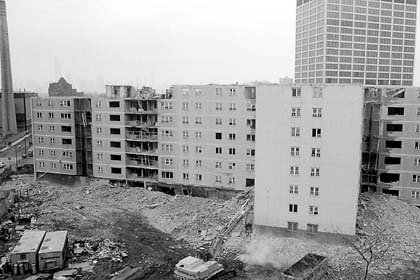
Consider what residents living in communities being "transformed" see from their windows and what they hear as they go about their days. This slide show evokes the latter stages of the demolition last spring of 3517-19 South Federal—a building known as "The Kingdom"—as seen and heard by residents living in 3547-49 South Federal, a building now empty and being prepared for demolition later this fall.
Plans are in progress for the redevelopment of abandoned communities such as Stateway into "mixed income neighborhoods" that will provide quality housing for at least some of the families that have been forced to relocate. The federal government has committed resources to the redevelopment process. Resident leaders are engaged in ongoing negotiations with the CHA to make sure the city honors its commitments. Amid unresolved issues, competing agendas, and contingencies, these processes are advancing. Yet they remain largely invisible to residents. What vision of the future can one hold in focus, when one looks out the window at the dismantling of one's community? What messages can be heard over the sounds of demolition?
The Summer Food Program
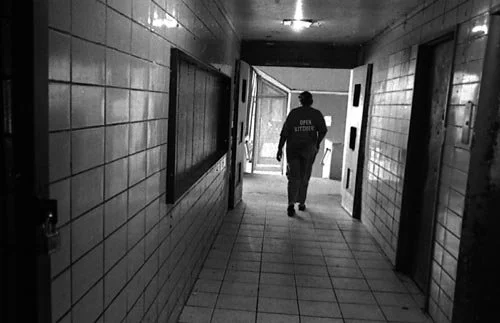
It all begins with an idea.The return of children to school last month marked the end of the Summer Food Service Program for this year. Funded by the Illinois State Board of Education, the program extends the anti-hunger programming offered in the public schools through the summer months. Over a 47 day period, an army of volunteers serve breakfast and lunch to children throughout the Chicago Housing Authority. At its height in the mid-1990’s, the program budget was $7 million. There were 224 sites at which 1,500 volunteers daily served 18,000 breakfasts and 27,000 – 30,000 lunches. As the dismantling of Chicago public housing has advanced in recent years, the scope of the program has diminished. Yet it remains an extraordinary administrative and logistical achievement: a glimpse of what is possible, when resources are made available for residents to provide services to their neighbors. Take a look.
The Vigil Against Violence
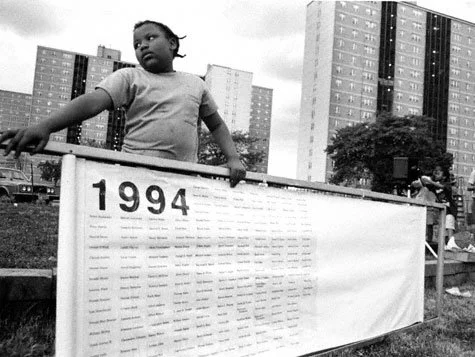
For five years—from January, 1994 to December, 1998—a group of citizens gathered on the corner of 35th and State at twilight on the first Sunday of each month to read the names of those lost to violence on the South Side. Initiated by Rev. Susan Johnson of Hyde Park Union Church, Dr. Sokoni Karanja of Centers for New Horizons, and myself, Vigil Against Violence was at once an expression of resistance and an occasion for reflection. It was, as one regular participant put it, a way of “making oneself available to the problem.”
Sustained from month to month and year to year by the moral passion and clarity of purpose of Rev. Johnson, and nourished by the sense of fellowship that developed among the core group of participants, the vigils were simple occasions: a few words of introduction by a member of the community, the reading of the names, and sometimes a little music.
On this first Sunday of the month of October in a year when Chicago may again lead the nation’s cities in homicides as it did last year, The View remembers Vigil Against Violence in a photo essay by Patricia Evans composed of images drawn from the posters we created each month to announce the next vigil.

The Writing on the Wall: A Love Letter
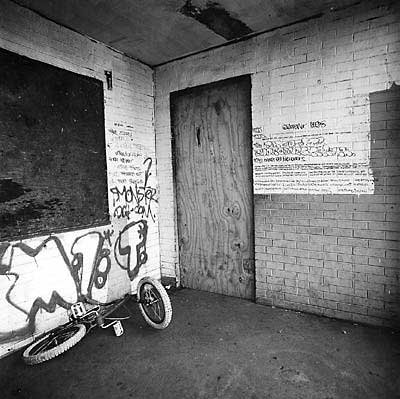
On a wall beside a vacant apartment on the seventh floor of 3542 South State Street—a high-rise at Stateway Gardens known as "The House of Pain"—words of ardor and longing flow across rows of brick.